02
Family Room
Saturday night, board-game table Primaries on cream. Big chunky cards. Grandparent-readable.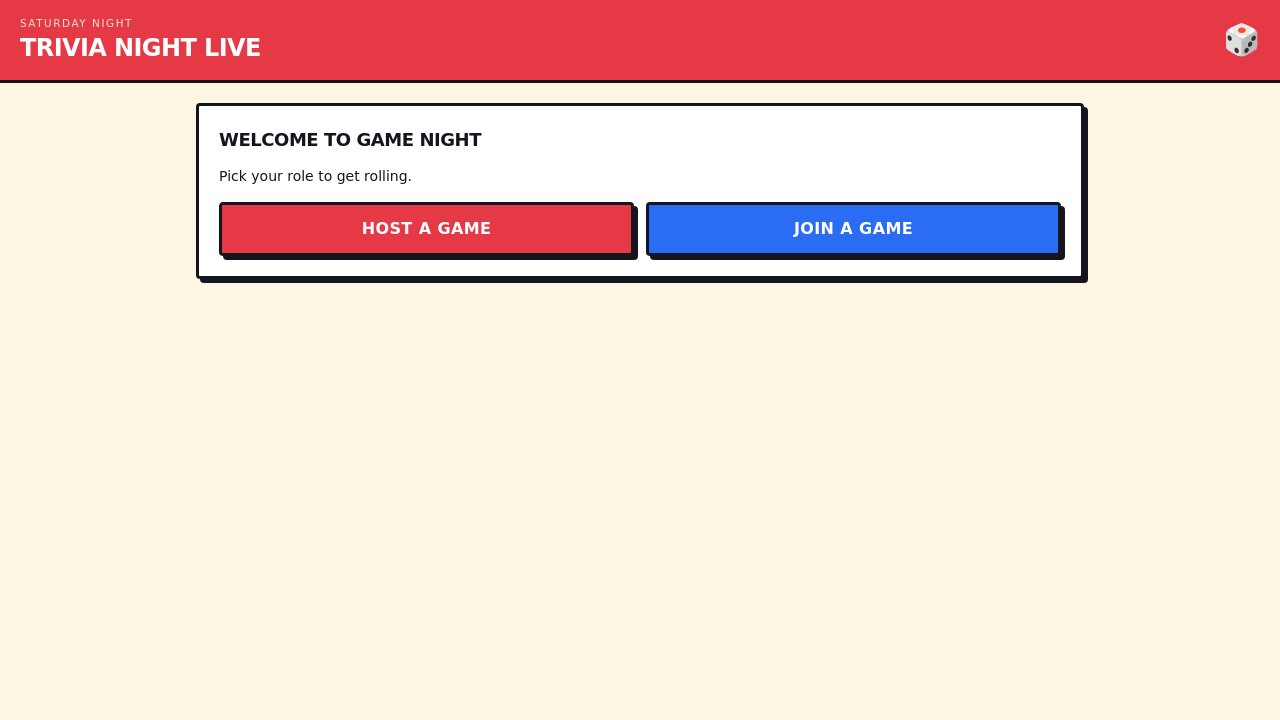
Host taps one button. Every phone in the room flips to the question at the same instant. Countdown ticks together. Answer reveal lands in unison gasps. One link runs the whole room: anyone with it watches, and each team signs in on one phone to answer.
The bar's regular host taps Next Question and 12 tables flip to it at the same instant. No paper sheets, no clipboards, no Buzztime tablets. The host's phone is the rig; every table's phone is a buzzer; the answer reveal lands in unison and the room gasps or groans together. The last round's winners get their team name chalked at the top until next Tuesday.
One host, any number of teams, one URL per game. The host opens the host view, gets a four-letter code and a QR. Teams scan the QR and sign in on one phone per team. Tap Next Question — every joined phone flips to it at the same instant, because the host’s tap saves one shared start time and every phone counts down to it. The 20-second countdown ticks in lockstep. Teams tap their answer; it locks at zero. Host taps Show Answer — every phone reveals correct, scores update, leaderboard re-sorts.
Paper sheets and a clipboard. Or a $1,000/month Buzztime tablet rig. Now it's a URL.
Your crowd has a thing — add a themed round, change the scoring, set a different countdown. Clone it and describe what’s different.
Five rooms is a starting point. Your Wednesday bar has different regulars than the Tuesday one. Your family argues about categories in a way no template predicts. A standing league fits too — ask for “our pub league’s season standings, for the teams I invite, carried week to week” and the room stays with the teams you invite. Your faculty club’s questions skew weirder than any question bank. Clone the room closest to yours and describe what changes — the palette, the categories, the countdown length, the tiebreaker rule. The one that fits your night is a prompt away.