Music / Sound Studies

Music, Sound
& Culture

Tools for exploring jazz history, improvisation traditions, and music's role in society — drawn from MIT OCW and UT Austin curricula.

jazz improvisationfree improvisationjazz historycritical listeningAfrican American musicjazz idiomcomposition vs. performanceensemble improvisationmusic and societynon-western traditionscomputational music
Exploration tools
01
Live

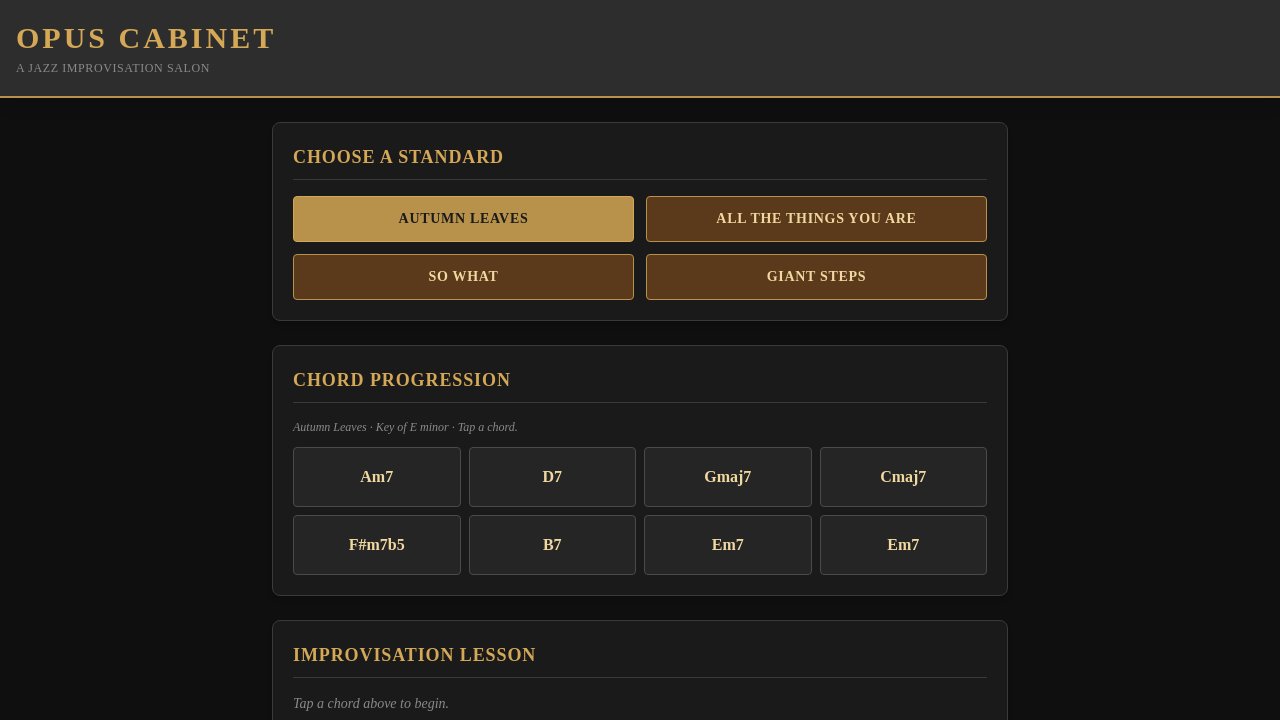
Jazz Improv Explainer

Pick a jazz standard. Trace the chord changes, the modes, how improvisers navigate the form.

Pick a jazz standard and trace how improvisers navigate it — the chord changes, the available modes over each chord, and how bebop, modal, and free approaches handle the same harmonic material differently.
02
Live

Jazz Age Explorer

Pick a decade. Key recordings, musicians, venues, social context.

Pick a decade of jazz history and see the key recordings, the musicians, the clubs and venues, and the social context — how jazz evolved from New Orleans through bebop, cool, free, and fusion.

03
Live

Jazz Guide

Pick a recording. Get a framework for hearing what's happening.

Pick a jazz recording and get a structured listening framework — instrumentation, form, soloist choices, rhythm section interaction, and how the recording fits its historical moment and stylistic context.

04
Live

Marginalia Codex

Pick a genre. Who made it, who consumed it, what it meant to its community.

Pick a musical genre and trace its social context — who created it, who the audience was, how it was received by the mainstream, what it meant to its originating community, and how that meaning changed.

05
Live

Improv Traditions

Jazz vs. Indian classical, free jazz vs. gamelan — how each approaches the individual-ensemble relationship.

Pick two improvisation traditions and compare how each approaches melody, rhythm, structure, and the relationship between the individual soloist and the ensemble — what each tradition values and why.

Make your own on vibes.diy →