Data Science / Statistics

Causal
Inference

Tools for understanding causal claims, directed acyclic graphs, and quasi-experimental designs — drawn from MIT, Stanford, UC Berkeley, Carnegie Mellon, and UT Austin curricula.

potential outcomes frameworkinstrumental variablesregression discontinuity designdifference-in-differencesdirected acyclic graphspropensity score methodsmatching estimatorssynthetic controlstreatment effect heterogeneitypanel data methodstwo-stage least squaresrandomized controlled trials
Exploration tools
01
Live

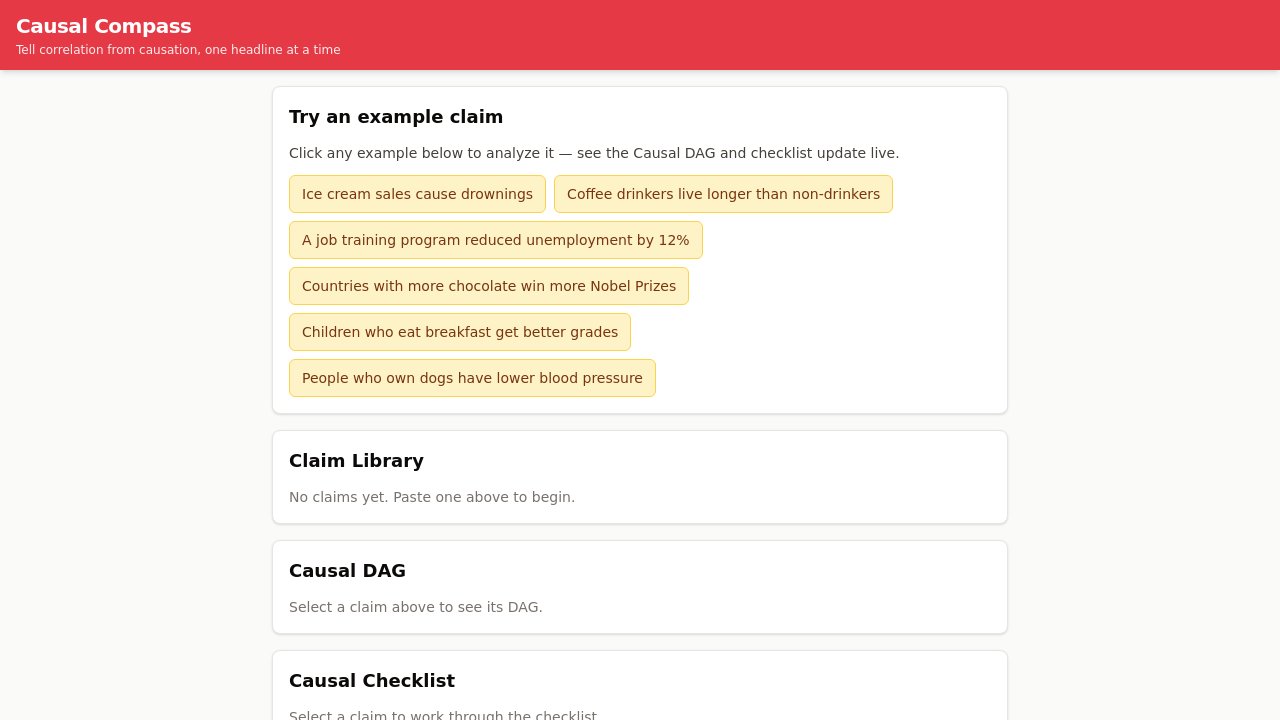
Causal Claim Checker

Ice cream causes drownings? Paste a headline, draw the DAG.

Paste a news headline making a causal claim. Name the treatment and outcome, identify confounders, draw a directed acyclic graph, and work through the potential outcomes framework — what would have happened to the same units without treatment?
02
Live

Methods Reading Group

One paper. One method. Collective sense-making.

Coordinate a causal inference reading group. Members tag the method used (DiD, RDD, IV, propensity score), sketch a DAG, vote on whether the identifying assumption holds, and build a shared library of papers worked through together.

03
Live

Design Workshop

Name the treatment. Draw the DAG. Pick the design. State the assumption.

Work through causal inference problem sets: given a real scenario (school tutoring rollout, minimum wage change, hospital admission threshold), pick the right design — RDD, DiD, IV, or synthetic controls — and articulate the identifying assumption.

04
Live

Methods Memo Builder

Staggered adoption, parallel trends, Callaway-Sant'Anna — design before you touch the data.

Design a difference-in-differences analysis with staggered treatment timing. Articulate the parallel trends assumption in your specific case, choose the estimator family, plan heterogeneity analysis by subgroup, and produce a structured methods memo for your supervisor.

05
Live

Evidence Review

Design, assumption, robustness — a rigorous protocol for every submitted evaluation.

Review program evaluation reports for causal credibility: log the claimed treatment and outcome, draw the DAG, evaluate the identifying assumption, check robustness, and rate overall credibility on a structured rubric defensible to federal oversight.

Make your own on vibes.diy →