Economics / Social Science

Behavioral
Economics

Tools for exploring prospect theory, loss aversion, nudge design, and the behavioral science of policy decisions — drawn from MIT, Stanford, UC Berkeley, and UT Austin curricula.

prospect theoryloss aversionpresent biashyperbolic discountingbounded rationalitynudge theoryframing effectsreference-dependent preferencesheuristics and biasessocial preferencesendowment effectintertemporal choice
Exploration tools
01
Live

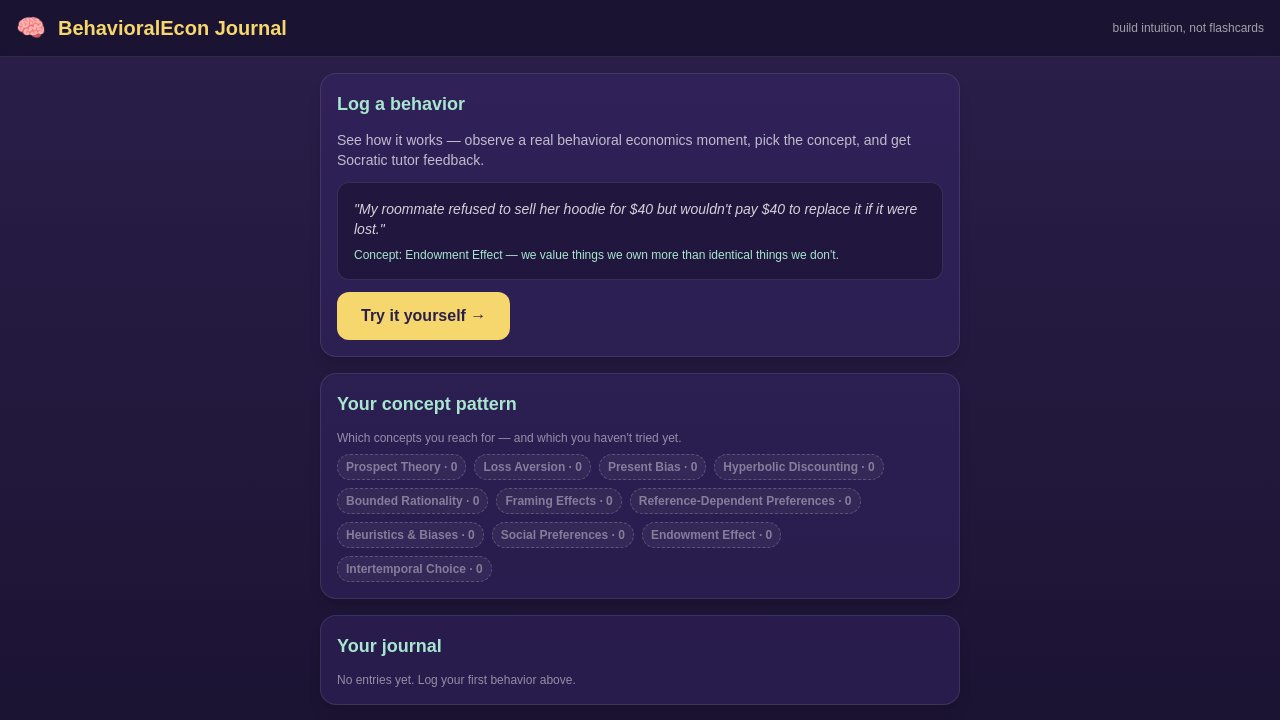
Behavior Journal

Log an episode. Name the bias. Defend the pick.

Pick a real-world behavior — your own or someone else's — and identify which behavioral economics concept explains it: prospect theory, loss aversion, present bias, framing effects, or the endowment effect. The app challenges your reasoning and tracks which concepts you over-apply.
02
Live

Book Club Map

Chapter by chapter, build a shared concept map.

Coordinate a behavioral economics reading group around Thinking, Fast and Slow, Nudge, or Misbehaving. Members claim chapters, log key concepts, attach real-world examples, and build a collaborative map of the whole book — navigable by concept or by chapter.

03
Live

Nudge Pipeline

Design → Review → Pilot → Evaluate. Track every intervention.

Manage a portfolio of behavioral nudges through their full lifecycle: design brief, behavioral mechanism selection, pilot launch, and evaluation. Institutional memory indexed by mechanism — search every past savings nudge and see which the team has been over-relying on.

04
Live

Experiment Design

Pre-register hypotheses before touching the data.

Design a randomized field experiment testing reference-dependent preferences in rideshare labor supply. Specify directional hypotheses under prospect theory vs. standard income-smoothing models, pre-commit to the analytic plan, and produce a complete pre-analysis plan ready for public registry.

05
Live

Policy Architecture

Default contribution rates, auto-escalation, opt-out mechanics — design the choice architecture.

Design the default architecture of a retirement savings program. Pull behavioral evidence on present bias, loss aversion, and social preferences; document load-bearing assumptions; run distributional analysis for subgroups whose reference-dependent preferences differ from the modal worker.

Make your own on vibes.diy →