Literature / Creative Writing / Media Arts

Algorithmic &
Experimental Writing

Tools for exploring Oulipo constraints, aleatoric methods, and language model authorship — drawn from SFPC and MIT OCW curricula.

Oulipo and constrained writingalgorithmic text generationlanguage modelsaleatoric writingagency and authorshipprogrammatic situationsconstrained writingprocedural generationgenerative textdivinatory ontologiesineffable meanings
Exploration tools
01
Live

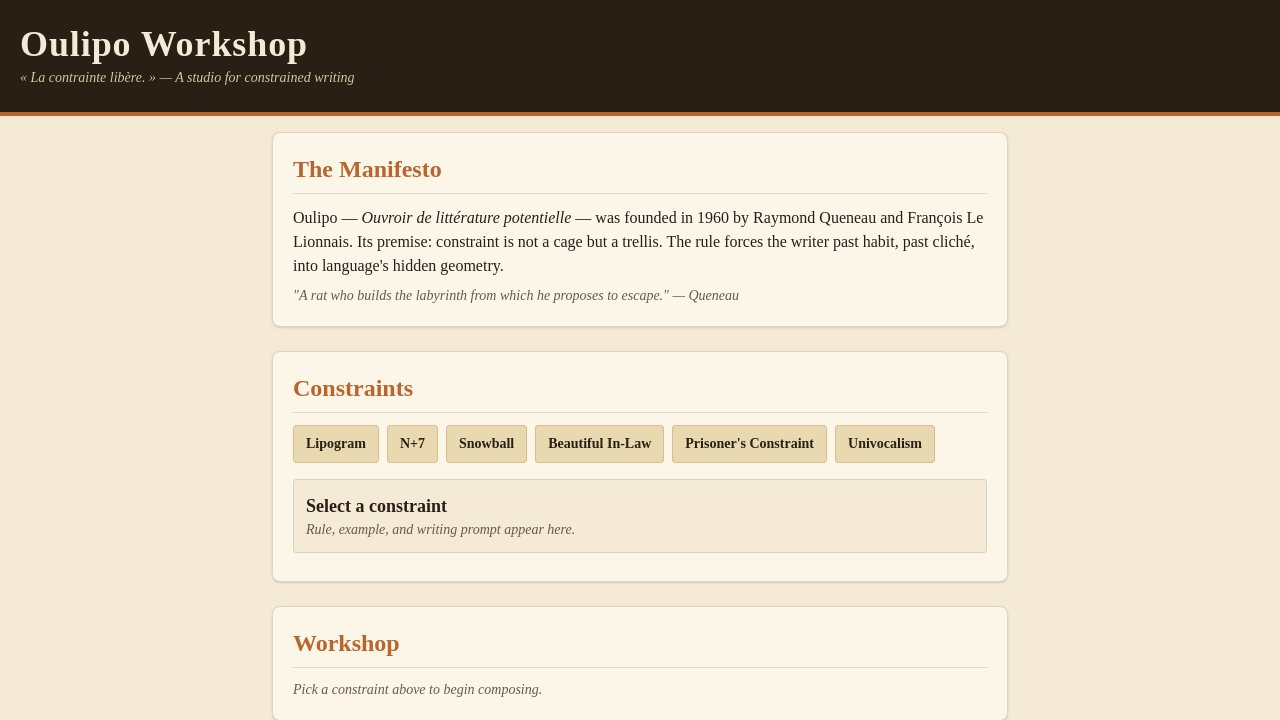
Oulipo Workshop

Lipogram, N+7, snowball — write under the constraint, see how Oulipo used it.

Pick an Oulipo writing constraint — lipogram (no letter E), N+7 (replace nouns with the 7th word after them in a dictionary), snowball — and get a prompt to write under it, with examples from Oulipo authors.
02
Live

Chance Workshop

Random word, dice roll, newspaper cut-up — how chance shapes authorship.

Pick a chance-based text generation rule — random word insertion, dice-roll decisions, newspaper cut-up — and produce a piece of constrained writing, exploring how aleatory methods challenge authorial control.

03
Live

Authorship Codex

Human-written, human-assisted, or AI-generated? What does the distinction mean for authorship?

Read excerpts and decide: human-written, human-assisted, or AI-generated? Then explore what the distinction actually means — for authorship, creativity, intent, and the history of experimental writing that preceded AI.

04
Live

Procedural Workshop

Describe a pattern. Apply it. See how constraints produce unexpected writing.

Describe a text generation pattern — every third word is a color, each sentence begins where the last one ended — and the app helps you apply it to produce a short experimental piece.

05
Live

Sigil And Sign

Tarot, I Ching, runes — how divinatory systems create meaning.

Pick a divinatory system and trace how its language creates meaning — the semantic space it constructs, the interpretive tradition that develops around it, and the role of the reader in completing the meaning.

Make your own on vibes.diy →