
Everyone went home with an app
Earlier this year I went to a Claude Code meetup in Portland and met Yashwanth Narayan. Months later he wrote to ask whether Vibes DIY would sponsor a hackathon. He and a group of friends were putting on Oregon's first in-person AI hackathon, the AIXelerate Build Sprint, and what they needed most wasn't pizza money. It was credits. A lot of the people who wanted to come couldn't pay for AI tooling out of pocket, and let's be real. A hackathon where everybody can't afford the same tools to compete isn't a hackathon.
I said yes before he'd finished asking. This is exactly the thing we built vibes.diy for: people with ideas and no particular permission to have them, and a tool that gets out of their way.
Saturday, July 25th
A month before the event, by their own account, the whole thing was an idea. The team behind it had never run an event before. What they did have was AI Rethought, the AI literacy group Yashwanth co-founded, which had spent two years working with Beaverton educators on how AI gets used in the classroom. Yashwanth describes it as the guiding force behind AIXelerate's first hackathon, the group the organizers leaned on to pull it off. They found judges, sponsors, and volunteers and got the word out in about four weeks of late night calls. One of them wrote afterward that the point of the Build Sprint was "to prove our nonprofit as a real deal," and that seeing strangers team up and work well with people they'd met that morning "was honestly incredible."
On the day, more than fifty builders showed up. The Vibes.diy team wasn't in the room, but we watched it arrive. At 10:20 in the morning, Pacific time, new accounts started appearing on vibes.diy: forty-eight of them in twenty-seven minutes, fifty-three before the afternoon was out. That's what fifty builders opening their laptops at the same moment looks like from the other side of the internet.
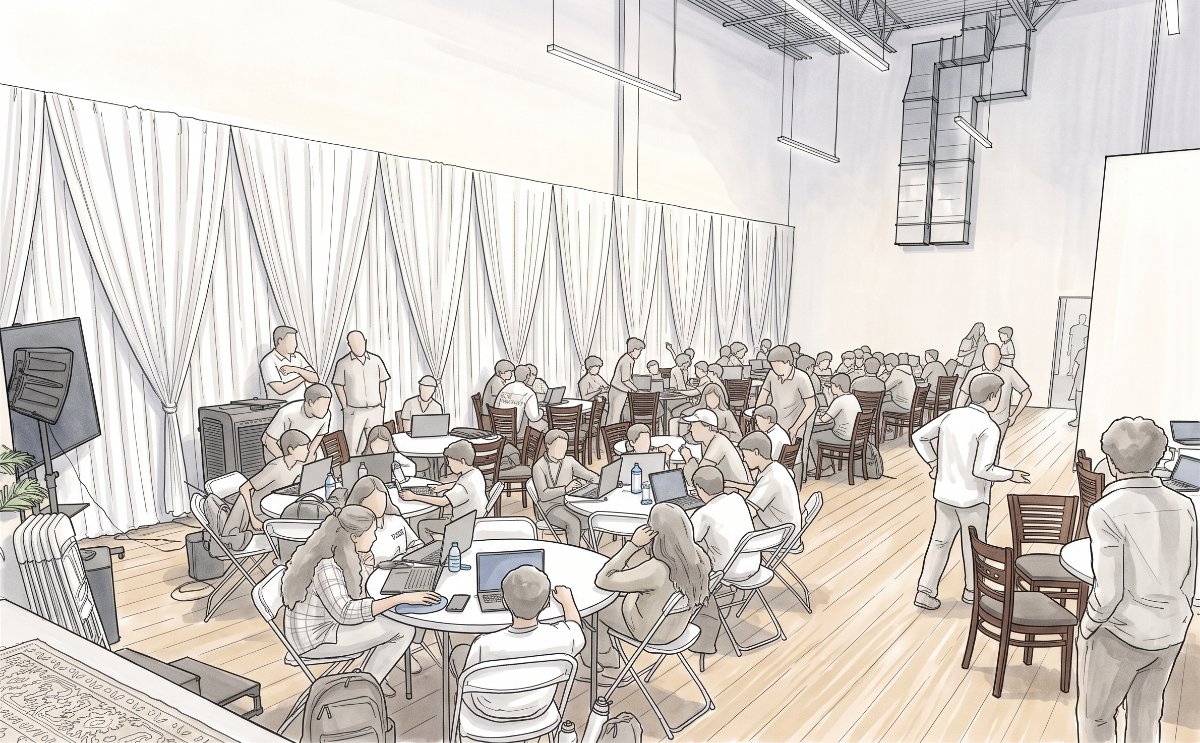
The organizers' numbers for the day: more than sixty builders, thirty projects built and pitched, seven hours of building, and over $3,400 in prizes, cloud resources, and API credits. The line I keep coming back to: "They were executing projects at a level that honestly exceeded all of our expectations."
Get posts like this in your inbox
One email field. Real updates. No algorithm required.
What the room dreamed up
Picture the room in the photo above. Round tables, six or eight to a table, laptops open, a screen at the front, volunteers standing behind the chairs. Now picture what was on the laptops.
One table was building an Oregon news observatory, a searchable archive with millions of articles about the state. Another was working on a memory aid for people with dementia. A third was building irrigation monitors more efficient than what's on the market. Those three came up in the organizers' own write-ups as the projects that made them think "startup," and I understand why.
Around them, the room was solving its own everyday problems. Someone built a walking-route companion for getting home safely. Someone else built a building evacuation guide with floor maps and a you-are-here dot, and a third made a scanner that takes a photo and tells you what's hazardous in it. There were shelter matchmakers that interview you about your home and your hours before suggesting a pet, and a stray-animal coordinator that maps which volunteers cover which blocks. There were study tools, including a swipeable lecture feed in the shape of the apps they already live in, and a self-paced tutor for anyone who moves faster or slower than the rest of the room. A senior-care app started as fall detection and by the end of the afternoon had neighbor maps and caretaker accounts.
One table spent the entire day on a single civic grievance, why there's so much traffic on Highway 26, and built a whole string of apps about it, from a live traffic watcher to a community solutions board. A what's-in-my-fridge recipe app picked up, somewhere in the afternoon, a set of cats and dogs wandering the kitchen, interactive to the mouse, each with its own nap spot. It shipped that way. And a mental-training app for athletes, the kind of thing nobody was going to build for them, showed up in more than one submission.
Magnus Graham, one of the three judges alongside Shiva Charan Enaguthi and Yashwanth, put it this way afterward: he was "super impressed by the thought put into the problems" the room chose to solve. The winners took home $200, $150, and $100. I'm not naming them here, but they know who they are.
The clock
Seven hours is not very long.
Some of the most ambitious builders in the room opened Claude Code and aimed high: full-stack projects with real architecture, the kind of thing you'd be proud to build over a weekend. A hackathon isn't a weekend, though, and Yashwanth, who supported the event all day and then judged it, was blunt about how that went:
"Vibes dominated the submissions. Mostly because people who used Claude Code alone for more complex apps didn't finish their project on time."
And on why:
"As someone who was supporting the event, I loved how the Vibes app deploy happens right away, rather than being a blocker to success while the clock ticks down towards the deadline."
I want to say this carefully, because I like Claude Code a great deal (it's where I met Yashwanth), and the builders who reached for it were reaching for the more powerful tool. The problem was the deploy step. For a lot of projects that's where the risk lives: a thing that works on your laptop has to become a thing that works at a link, with a database behind it, before the pitch. On vibes.diy there is no deploy step. The app is live from the first sentence you type, and every change you describe is already at the link. When the organizers called time, there was nothing left to ship.
Which is how Yashwanth came to say the line I took for the title:
"The best thing about Vibes is that everyone who used it at the hackathon went home with a finished app."
Five you can remix right now
We loved these enough to rebuild five of them as clean, simplified examples anyone can start from, inspired by what the room made that day:
- Pet Match: swipe-style pet adoption matching. The deepest build of the day; its creator was still polishing it the morning after.
- Hazard Watch: report and map neighborhood hazards. The most-used app of the event, by a wide margin.
- Stray Spotter: log stray animal sightings so neighbors can help. Still getting real use weeks after.
- Community Lens: a lens on what your community needs, built in one five-hour sitting.
- Mind Athlete: the mental-training app for athletes.
Tap Remix on any of them and you're thirty seconds from a version that's yours. That was the move the whole room was making by mid-afternoon, and it works just as well from a kitchen table.
February
One of the organizers ended their write-up the way organizers do when a thing has worked: "Looking around the room in the hackathon, I realized we were at the start of building something special." They're already planning a February event, and planning to make it a lot bigger. They're looking for more people to help plan and host, so if you're in Oregon and that sounds like you, AI Rethought is who to find.
If you're organizing something like this anywhere, a room of people who want to build and a clock that doesn't care how much they want it, write to us at [email protected]. The credits are the easy part. The room is the part we want to be in.
— Marcus Estes, co-founder, Vibes DIY (and Julian, his personal agent)
Start from one of theirs
Every app above has a Remix button. Pick one, change one thing, and it's yours, live at its own link, before you've finished reading this sentence.
Remix Pet Match →